Visualizzazione post con etichetta Driver. Mostra tutti i post

Review: Windows 10 RTM - Intel Atom (GMA 500)

Finally I decided to test the rtm version of Windows 10 Home 32 bit (Updated Sept 2015) and here there are my considerations.
The Intel Atom Z520 cpu and gma 500 aren't the best hardware for running this new OS but anyway with some tweak you can run it with enough satisfaction a basic Windows 10.


Let's start:
Min System Requirements:
-CPU 1GHz or faster with PAE,NX and SSE2
-RAM 1GB (32bit version)
-Hard Disk 16GB (32bit version)
-Graphic Card DirectX 9 with a WDDM driver

Test Device: Asus 1101HA with Intel Atom Z520 @1.33MHz, 2GB, Hardisk @5400rpm

Installing on my fresh cleaned hardisk ,i've immidiately found a bug on installer. Like in Inseder preview, is not possible to disable all functions in the setup (the installer will restart) so I've used common settings.
At the first boot (without any driver) there is something that isn't working correctly: CPU usage isn't costant in idle so i've started my optimization.
 
Installed Programs:
-All Suggested Updates until 08 sept 2015
-Adobe Flash Player for Qupzilla
-Qupzilla
-Video Driver Iemgd 1.18
-Optimus IEMGD 1.2 (internal test)
-Winrar
-K-lite codek pack 1140 LAV+DXVA2+Render stock
-Asus suite driver package by me (Asus ACPI, Asus SHE,Synaptics Driver). On Win 8.x and 10 synaptics driver uses 3% CPU always, it's a software problem. To solve it, if you don't need gestures, go to scheduler and disable synaptics autorun.

Reducing CPU,RAM and HD Stress
-Enabled hyperthrading
-Fixed Boot Settings because still win 8.1 option was present  (easyBCD tool)
-Disabled onedrive autorun
-Local account (suggested because preserve RAM,CPU and your Privacy)
-Avalon/WPF Disabled + no filter
-System V-sync Disabled
-Disabled 3 services
-Disabled milions of settings in settings\privacy ect
-Disabled UAC
-Setted no trasparent color for windows bar and start menu (i've also resized it)
-Disabled Windows Defender (reduce CPU stress; with No Defender tool but probably works also Winaero one)
-KMS for win 10 (with a fresh install you need a product key..so let's use warez)
-No hd buffering cache
-Qupzilla setted with: no scroll animations, chrome theme, enlarged cache,no osd,ect
-Disabled Synaptics Software Autorun from Scheduler
-Disabled Cortana (reduce CPU,RAM stress and improve your Privacy
-Disabled momentarily Fast Boot to renable SHE overclock at 30% (only for Asus 1101HA)
-HKEY_CURRENT_USER\Control Panel\Desktop|"MenuShowDelay"="0"
-HKEY_CURRENT_USER\Control Panel\Mouse|"MouseHoverTime"="0"
-Disabled Notification Center: HKEY_CURRENT_USER\SOFTWARE\Policies\Microsoft\Windows\Explorer DWORD:DisableNotificationCenter =1
-Disabled Windows Defender notification
-Disabled Microsoft Visual Effects too heavy for GMA500
-Removed Store and Windows App (film and TV ect,ect. My device doesn't have enough power for HTML5) via Powershell command
-Removed OneDrive link from start menu
-Disabled Windows Update
-Superfetch setted registry value: 2=Only on boot (i know it is usefull but when HD is above 80% of usage system is slow: hardware limit )
-Removed all password requests

Initial Results:
It is faster than win 8.1 and Win 7
CPU usage in idle 5'min after boot =  2%
RAM usage in idle 5'min after boot =  30%
Hardisk space 11.6GB
Adele set fire HD fullscreen and windowed youtube @1.33GHz with Multipler x10 = 10-12 fps
Adele set fire HD fullscreen youtube @1.74GHz with Multipler x10= 10-14 fps
Adele set fire 480p fullscreen and windowed youtybe @1.74GHz with Multipler x10= 13-16 fps
As always no hardware opengl supported and restart pc causes BSoD with intel embedded driver
Few glitches
Reduced  compatibility with old games: FIFA 2002 demo crash, GTA III really low fps also after update the diretx SDK. Note. Version of diretx used by gpu in win 10 is 9Ex.
System stability and multimedia work Good! Anyway embedded video driver works a little better with win 7, expecially for opengl and old game.
This test is only to show how is possible to optimize windows, but is too extreme because it leaves the core system. Without many services system is faster than windows 7 but you will only have an updated GUI OS with many problems with old programs and worst gpu performance. I still love windows 7 home premium 32bit
Bugs\Info with Intel Embedded driver for GMA 500:
-Restarting PC causes BsoD (IEMGD problem) Seems to be bugfixed in newer release
-Metro Video App doesn't use Hardware rendering anyway desktop mediaplayer uses it
-No Hardware OpenGL rendering (you can still use MESA3D OpenGL but are software accelerated and so slow)
+Using QupZilla,as web browser, Adobe Flash Player uses hardware rendering for Video decoding and rendering (so supported HD videos on youtube).Strange behaviour of Adobe Plugins: The performance are really slow with Chrome and Internet Explorer where Video decoding is software while in FireFox and Opera is hardware.
-HTML5 Videos are not supported by GPU so only an intel Z540 can play this format quickly.
-Cold system boot with IEMGD Driver: 25' sec (on win 8.1 = 40')
-RAM usage with few tips and IEMGD Driver 32% (on win 8.1=  range 35-40%)
-More stable than Win 8 with Embedded Video Driver
-Better performance than Win 8 (GMA 500 works better with Windows 7)
-My package Asus Suite Driver works correctly (overclock and Fn functions)


Still need to check if it is possible:
-Remove Windows Feedback app or link in start menu
-Remove Contact Support app or link in start menu
-Remove Cortana app or link in start menu

Still not performed: 
-Disable some service
-No windows indexer
-Fix paging file

Edit. Retested Jan 2021 Nothing more to say require a lot of time to disable services. Not suggested! Disable DWM mode is changed in years, it is still disable but with a lot of problems. Remember the best OS of this soc is Windows 7 where you can play with xpdm or wddm driver and optimize tasks

Linux on GMA 500

NOTE. If you are a linux user with gma 500 video card ,please, add a comment with your experience ;)
Let's start saying that GMA 500 works better with Microsoft products but anyway linux distros may be faster than Win 7. (I'm talking about system speed but i'm not so sure vs winxp and win 7 with classic theme + tweaks on US15 platform)
Linux is an opensource OS but,unfortunately, this has determinate the emergence of billions of distros that sometimes may confuse users migrating from other OS like MS or Mac...anyway leaving my thoughts let's talk of GMA 500 vs Linux.
I will not speak about the problems in linux with drivers (you can find some bugfix googling: like how to restore backlight,correct the resolution,resolve black screen), but i will show you a first look of the driver situation on Linux (April 2014)

First step "How to install a Linux distro"
1)Download UNetbootin
2)From the program choose if download a distro (check the list) or simply add an iso (downloaded before)
NOTE.Min Requirements  Ubuntu 12.04's distro: CPU 300MHz;  384MB RAM; 1GB Hard Disk; Display 640x480

Available Drivers
Theare two main partial working driver for US15 platform:
1)gma500_gfx, an updated version of psb_gfx, that is included since ubuntu 12.04
2)EMGD official, an updated version of IEGD for Fedora 7, that support Fedora 14 (Kernel version 2.6.35)
Intel EMGD was modified to make it working also in other distros like Ubuntu/Xubuntu/Lubuntu/ect but works only in few distros (in a first moment it was working only with kernel <3.0 (build max May 2011), now it's possible to install it with some trick but not always.

Why there is no open-source driver
Intel reply: Unfortunately we are not able to support all of the various distributions of Linux that are available. It is simply not practical to do that, and we are not able to provide 100% of the source code due to some IP involved in the media and 3d acceleration portions of the driver.

N.B.Reading from ubuntu pages: upgrade to ubuntu>12.04 isn't suggested for poor performance with the gpu

Main Difference: 
-gma500_gfx is Software Accelerated Driver (so performance depends by your CPU better with Atom >Z530 or overclocked CPU)
-EMGD\IEGD is Hardware Accelerated (better performance and less power consumption)
-----------------------------------------------------------------------------------------------------------------------

NOTE for Terminal:
RAM available  "free"
Driver Installed "lsmod | grep gma" check that gma500_gfx is installed if you are not using EMG
-----------------------------------------------------------------------------------------------------------------------
[TESTs]
Device: Asus 1101ha @1.33GHz, 2GB RAM, GMA 500, 1366x768 display

A)Ubuntu 12.04 (screen resolution 1366x768 is auto detected):
YouTube.com  WINDOWED - FULLSCREEN
1080p:             3  FPS             2FPS
720p:               3  FPS             3FPS
480p                9  FPS             5FPS
380p                25FPS             7FPS

AVI Trailer with default player:
1080p <1FPS
720p   <1FPS

Adding Suggested Tips: Ubuntu WIKI
A)"MPlayer"
<<Due to the lack of Hardware accelerated video playback in the gma500_gtx kernel driver, at current video playback can be very slow, it can freeze, jump and the audio and video can desynchronise, However it is possible to avoid this by using mplayer with multithreading>>
1. Install mplayer: sudo apt-get install mplayer
2. Go into the directory containing your video: in my case was "cd /home/eeepc/Scaricati" where eeepc is my username and Scaricati is Downloads folder
3. Play the video: "mplayer -lavdopts threads=4 -framedrop yourvideofile.avi" in my case was born.mp4 fullhd video 
This will drop frames when needed, and use 4 threads (You should change this depending on your Atom Processor) meaning playing HD video is possible.
Result: Better situation than default player but 720p video runs still 1FPS
B)Adding more RAM to the GPU:
sudo gedit /etc/default/grub   This will open grub with administrator rights
Add one of these lines and save the file:
For 1GB devices  GRUB_CMDLINE_LINUX="mem=896mb"
For 2GB devices  GRUB_CMDLINE_LINUX="mem=1920mb"
sudo update-grub 'To update grub informations

Conclusion: Poor Multimedia Performance (Windows wins without any dubt)

B)Fedora 14 (codename Laughlin, November 2010) this version is directly supported by IEMGD but i haven't still test this driver.
Comments without IEMGD: Slow boot, with basic driver max resolution is 1024x768;  old basic video driver has slow performance; RAM USAGE 170MB

C)Lubuntu 13.10 (Autodetect 1366x768 display)
Really better than Ubuntu 12.04 and Fedora 14, system is fast but anyway GPU driver is gma500_gfx so it's only Software Accelerated.
RAM USAGE: 100MB with default driver
This Distro is faster than Win7 and is suggested only for DESKTOP USAGE.

VIDEOs:
DIVX full Supported (<720p)
720p: Atom Z520 CPU Usage 98%, watchable but audio async
1080p: Lags, a lot of frame skips (not suggested)

YouTube.com  WINDOWED - FULLSCREEN
1080p:             3  FPS             2FPS
720p:               10  FPS             3FPS
480p                15  FPS             6FPS
380p                25FPS             10FPS
Note don't play anything else!


D)LUBUNTU 14.04.5 LTS + EMGD
Should be supported also 16 but in my test OS not loaded after install emgd 
You can install also Ubuntu with command written down but for edit files you can't use leafpad but gedit
Idle RAM: 135MB
Low EMGD rendering vs Windows EMGD
EMGD package upgrade  Xorg from 1.18.3 to 1.9.5/1.9.6

-------
INSTALLING EMGD and Enabling VAAPI on Ubuntu 10.04 (Guide by Linux-Tipps.blogspot.com)
Other Infos about Ubuntu 9.10: HERE
1)Download and install EMGD
sudo add-apt-repository ppa:gma500/ppa
sudo add-apt-repository ppa:gma500/fix
sudo apt-get update
sudo apt-get install poulsbo-driver-3d

2)Reboot OS
3)Set up Xorg.conf:
Section "DRI"
Mode 0666
EndSection


Section "Device"
Identifier "GMA500"
Option "AccelMethod" "EXA"
Option "DRI" "on"
Option "MigrationHeuristic" "greedy"
Option "IgnoreACPI" "yes"
Driver "psb"
EndSection

4)Reboot OS
5)VideoPlayers:
wget http://www.splitted-desktop.com/~gbeauchesne/mplayer-vaapi/mplayer-vaapi-20100114.i686.tar.bz2
unp mplayer-vaapi*

sudo apt-get install mplayer libgtop2-7
mplayer -vo vaapi -va vaapi testfile.avi

VLC: 
sudo add-apt-repository ppa:c-korn/vlc && sudo apt-get update && sudo apt-get install vlc

INSTALLING in LUBUNTU 14.04 or UBUNTU (another way)
1) Open LX terminal
sudo add-apt-repository ppa:thopiekar/emgd
sudo apt-get update
sudo apt-get install emgd-drm-dkms xserver-xorg-1.9-video-emgd
 
2)it's time to blacklist gma500_gfx default driver
sudo leafpad 
and compile and save in /etc/modprobe.d/blacklist-gma500.conf (paste following content)
#use the EMGD driver instead
blacklist gma500_gfx
 
3)Configure Xorg in /etc/X11/xorg.conf
sudo leafpad 
Paste this:
Section "Device"
    Identifier "Intel EMGD"
    Driver     "emgd"
EndSection

Section "Screen"
 Identifier "Screen0"
 Device "Intel EMGD"
 SubSection "Display"
  Modes "1366x768"
 EndSubSection
EndSection
 
4)Fixing Audio
Edit and save the file /etc/pulse/default.pa always whit sudo leafpad
search  for load-module module-udev-detect and add tsched=0
result:  load-module module-udev-detect tsched=0
 
My conclusion: 
Linux actually, in this kind of platform, is good for desktop usage but not for Multimedia purpose (there are still too many websites with media contents). System can run, via Software Rendering, youtube but you need overclock to see  480p windowed videos.
The 3D Rendering is absent in gma500_gfx driver.
The EMGD for linux is still the best choice for multimedia goal but is outdated, not so fast, and not compatible with all distros (excellent combo!)
Start testing light distro like Lubuntu and Xubuntu

Take a look at these EXTERNAL LINKs for more infos:
https://launchpad.net/~gma500
https://launchpad.net/~thopiekar/+archive/emgd
https://github.com/EMGD-Community/intel-binaries-linux 
https://wiki.ubuntu.com/PoulsboObsoleteDrivers
http://ubuntuforums.org/showthread.php?t=1229345

EMGD driver


Release
Kernel
Xorg
EMGD Version
2D accel
3D compiz
Normal Video Playback (Xv)
Hardware Video Acceleration1

Oneiric (11.10) +
3.0.0-x
1.10
1.10+
N/A

3.0.0-x
Downgraded 1.9
1.8
Acceptable
Excellent
Excellent
Acceptable

Natty (11.04)
2.6.xx
1.10
1.10+
N/A

2.6.38-x
Downgraded 1.9
1.8
Acceptable
Excellent
Excellent
Acceptable

Lucid (10.04)
2.6.32-x
Upgraded 1.8
1.6
Acceptable
Excellent
Excellent
N/A

PSB driver


Release
Kernel
Xorg
2D accel
3D compiz
Normal Video Playback (Xv)
Hardware Video Acceleration1

Oneiric (11.10)
3.0.0-x
1.10
N/A

Natty (11.04)
Upgraded 2.6.39-rc1
1.10
N/A

2.6.38-x
1.10
N/A

Downgraded 2.6.35-x
1.10
Excellent
Bad
Acceptable
Excellent

Windows 8/8.1/10 : OpenGL 2.0 Issue


Introduction: DirectX and OpenGL are competing application programming interfaces (APIs) which can be used in applications to render 2D and 3D computer graphics, taking advantage of hardware acceleration when available.
GMA500, with Intel Embedded Graphic Driver, can run both these two APIs: DirectX9.0C and OPENGL2.0 
Issue on Windows 8\8.1\10: IEMGD can't run OpenGL(Open Graphics Library) 2.0 API

Why? Seems to be an installer problem of all GPU Drivers(compiled for Windows 7) for a new Windows 8 Setting vs OpenGL ICD (Installable Client Driver)
In Our Case:
-C:\Windows\System32\opengl32.dll Microsoft Windows 8 OpenGL 1.1 INCLUDED and Enabled
-C:\Windows\System32\igdogl32.dll Intel Embedded Driver OpenGL 2.0 INCLUDED and Disabled
Solutions Tested but not working (maybe can resolve other GPU's equal issue):
-Update the Driver (not available for GMA500)
-Registry Fix: Added the same keys of Win7
-Installer INF Fix: Fixed to install with WIN 6.1=7; WIN 6.2=8; WIN 6.3=8.1
-Compatibility Mode: Tested Win 8-7-Vista SP2-XP SP3
-Manual Driver Mode from Device Manager
-HKLM\SYSTEM\CurrentControlSet\Control\Class\{4d36e968-e325-11ce-bfc1-08002be10318}\0000 Checked
-Comparison between INI for Win7 vs INI for Win8
-Edited by Hex Editor: returns OpenGL error! 
PROBABLY not Fixable on GMA500 ; for all other Intel GMA GPUs just download updated driver or open inf file and edit strings for win 7 (NTx86.6.1) for ex:
 [Manufacturer]
%Intel%   = Intel.Mfg,NTx86.6.1
[Intel.Mfg.NTx86.6.1]
Change it to accept all OS versions(example above) or you can edit NTx86.6.1 to support only 6.2(win 8)/6.3(win 8.1):
[Manufacturer]
%Intel%   = Intel.Mfg
[Intel.Mfg]
Fixed Installer for Intel HD 1°gen and Intel Series 4 (not gma500) can be find HERE
Contacted: Microsoft,Intel,Asus,OpenGl,Forums...all saying it's an Intel issue! I hate this way to operate
Intel aswered that GMA500 is "EOL" (End of Life Support) so never will be available a solution from them!
P.S.For x64 OS is necessary disable Drive Digital Firm Check
Solutions still not Tested
Make a digital firm for developer
How to Install MESA3D Software Accelerated OpenGL on Windows 7/8/8.1 (probably also XP)
After many tests,research on MSDN and registry fixes,I understood that the error is ,in our unlucky case, in igdogl32.dll. Reverse isn't possible so We can't get OpenGL Hardware Accelerated!
The Only Workaround to play apps\games that requires OpenGL > vers 1.1 is to change Windows Software accelerated Opengl32.dll.
N.B. Performance are Poor (will not fixed with future releases so i will not update this package)
WORKS ON ALL PCs not only GMA500 Devices!
Options: 1) MESA3D OpenGL (described and free) 2) TitaniumGL (Trial version and only OpenGL1.4)

Instructions:
1)Go to Download Section and download Mesa 3D - Wrappers Package (contains MESA3D Software Acc OpenGL Dic 2017)
2)Follow instructions: (three possible solutions)
-First Option,suggested, put opengl32.dll directly in game\app folder (may not work)
-Second Option for GMA500 rename package opengl32.dll to igdogl32.dll and put it in system32 (overwrite existing unworking dll)
-Third Option overwrite C:\Windows\System32\Opengl32.dll with MESA dll as described above: (if your video driver has no opengl file)

A.Make a backup of Windows OpenGL to restore it in the future 
B. Go to system32\opengl32.dll file, right click properties. Click on Security tab\Modify\Select "Users" Profile and check Full Control then OK->OK
C.Overwrite system32\opengl32.dll with mesa dll (32bit or 64bit dipends from your OS)
  

Windows 8.1 PRO Update1 : Intel Atom Z520 (April 2014)

-Processor: 1 gigahertz (GHz) o better with  PAE, NX and SSE2 support
-RAM: 1 GB (32 bit) or 2 GB (64 bit) [I suggest to install 32bit version only with  2GB on Atom devices]
-Free Space: 16 GB (32 bit) or 20 GB (64 bit)
-Graphic Card: Microsoft DirectX 9 with WDDM driver

Note.Windows Xp system minimum requirements (Pentium 233 MHz, 64 MB RAM, 1,5 GB hardisk;VGA 800 x 600)

Starting Tweaks: (read HERE)
-Hyper Threading
-No paging file
-Small taskbar buttons
-Go to desktop instead of start (when loading)
-Start show apps directly (when use metro)
-Disabled UAC and SmartScreen (useful only for a "foolish user")
-Classic Shell (close metro\moder UI for a classic win7 experience)
-Remove all password requests from login

Removing Login: Right Click on Start Icon\Run (or Win+R) then insert "netplwiz":
Settings\change PC settings\Accounts\Sign-in Options:

Comments:
Metro Ui  Speed with GMA500 and Z520@1.33Ghz VOTE: 5.5 ->lag between first screen and Apps section (probably will be released some patch to make it quicker)
BSoD observed with: "When I point  to the upper-left corner, switch between my recent apps"
(ITA Passa da un' app recente all'altra quando si fa click sull'angolo sinistro).


  • Keyboard Commands
Win+F1  Help
Win+F3/W/Q/S/F Search
Win+Pause System
Win+1/2/3/ects Run first/second/ect. icon in taskbar
Win+ "+"  Zoom in
Win+P Project to a connected screen
Win+I Settings
Win+U Ease of Access Center
Win+T select a taskbar icon
Win+R Run
Win+E This PC (ex Local)
Win+D Minimize Program
Win+H Share
Win+K Devices
Win+L Lockscreen (with password)
Win+ "." Select Multidesktop
Win+"-" Zoom out
Win+B Select a tray icon
Win+C Smart menu or Charm Menu
Win+X  Right click on Start icon
Win+Enter Run Narrator (text reader)

  • Mouse Commands
Right side of the screen: Smart Menu
Right click on Start Icon: Context menu
Left down corner Start Icon
Left high corner Multitasking viewer(after it show an image go down to left side screen It will open a complete Multitasking menu
Upside of the screen Resize windows (metro GUI)
Do you know other Keys\mouse combinations?


Conclusion  test:
  1. Suspension-Hibernation works correctly
  2. My package Asus Drivers Suite (SHE and Hotkeys Service) works perfectly
  3. Metro GUI  is faster removing\unpin some icon and effects
  4. Graphic problems with GAMES on Opengl and Directx (IEMGD 1.18 problem)
  5. Ram usage  about 500MB in idle 5' min (with Z5xx series use only 2GB 800Mhz CL5)
  6. Windows adjust directly Intel Multipler range:  x10 - x6 (depends from CPU load :1.33MHz to 798Mhz)
  7. Classic Shell,an opensource program, can eliminate Metro\Modern UI and restore Win7 experience (note: Start icon is editable)
  8. Windows Market has many apps and games (probably someone will works with GMA500)
  9. MediaPlayer Classic works correctly (no problems with fullhd or HD video like win7)
  10. OpenGL 2.0 isn't working (also in Windows 8 Preview,Windows 8, Windows 8.1 Preview)
  11. Startup is faster then older MS OSs (removed Safe Menu from boot)
-Ram Usage in idle after 5 min: about 500MB with IEMGD 1.18 (I'm not still satisfied)
-Left Upper Corner (Recent App): Disabled by Default (before update 1 it caused BSoD)
-Restarting the PC: causes BSoD (Fixed in 2016 package. Not still available)
-Apps loading still some graphic errors: Minor bug (only for 2 seconds)
-Metro Apps doesn't use Hardware acceleration (video app is too low using CPU decoding on Z520)
-System is faster than Windows 7
-IEMGD OpenGL Hardware Accelerated doesn't work on Win 8 (use MESA3D opengl in Download section: them are software accelerated = SLOW in Atom Z520)
-Internet Explorer use wrongly the adobe hardware acceleration (use it for rendering and not for decoding)
-Update1 brings about 10% of optimization so better than Win 8.1
-Probably better performance on 1024x768 display or less on Metro (my panel is 1366x768)
-Windows 7 seems to have a better Adobe Flash Player speed (see section Browser-Adobe flash player)
[TEST Video]: Adele - Set Fire to the Rain (Live to the Royal Albert Hall) + Opera Browser 12.16
-ATOM Z520 1.33GHz 1366x768 display-
HD Large Window: 12 FPS
HD Normal Window: 13 FPS
480p Fullscreen: 13 FPS
480p Large window: 16 FPS 
480p Normal window 17 FPS
360p Fullscreen: 18 FPS
360p Large Window: 22 FPS
360p Normal Window: >24 FPS

ASUS SHE fixed for Z5xx devices compatible with Win 8\8.1 is available HERE
NOTE.After only 12 years, Microsoft XP Support is closed! No more Security Updates will come from Windows Update so Users start thinking to migrate to a newer OS or use a really good Firewall\Antivirus (it isn't the best choice).

WINDOWS MICRO EDITION


There are to many Editions of MS Windows someone develop by Microsoft and someone by Modders.
Let's try to make a mini list with common Releases compatible with "Normal Multipurpose x86 (32bit)" devices:
-Windows 8 Embedded Standard
-Windows 8 Lite (Mod Version) [Check on Google]
-Windows 7 Home Basic (equal to Win7 starter but without limitations)
-Windows 7 Embedded Standard (Compact Version has also ARM processors support)
-Windows 7 ThinPC (the official MS O.S. studied for old PC) DOWNLOAD
-Windows 7 Modded Versions
-Windows XP SP3 Embedded
-Windows XP Fundamentals for Legacy PCs (not suggested!)
-Windows XP Modded Versions [Check on Google: there are too many versions called with many names like Lite,Black Edition,EEEpc ect,ect]
Note.HERE Some Comments about ThinPC

[Versions TESTED on Asus 1101HA]
MicroXp 0.82 SP3 by eXPerience--> RAM Usage 40MB - Pacchetto Installazione: 102MB
MicroXP Pro SP3 1.0 by DarkReverser--> RAM Usage 50MB - Pacchetto Installazione: 181MB
Lingua delle due distribuzioni INGLESE
Attivati!

Pensavo che il ritorno a XP dopo anni di Windows 7 mi avrebbe ucciso e invece sono abbastanza soddisfatto del risultato finale!
Sto utilizzando la versione DarkReverser in quanto,secondo alcuni, più sicura e affidabile (10MB di Ram per queste caratteristiche li posso anche buttare :D ).
I 50MB di utilizzo da parte del sistema fanno sorridere ma vengono subito colmati dall'utilizzo dei driver IEMGD per un totale di  circa 210MB (inclusi i programmi di sotto).
Veloce e stabile con gli ultimi aggiornamenti SP3.
Per chi fosse interessato a installarlo consiglio di scaricarsi,prima dell'installazione, i driver WIFI dal sito del proprio produttore.
Attualmente ho installato con successo:
Seven Remix XP (un tocco di Windows 7 fa sempre bene)
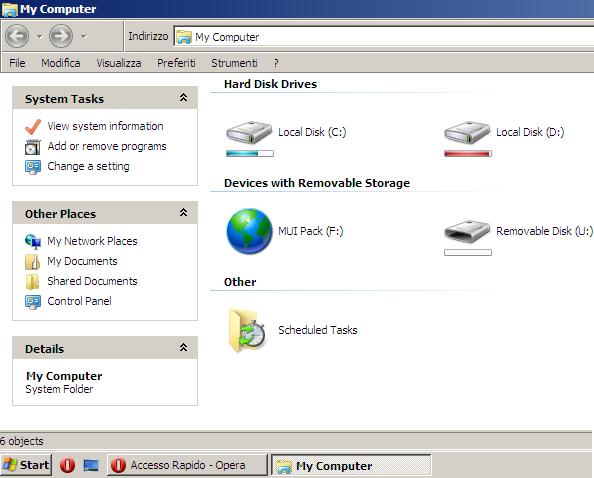
Language MUI Pack Italiano (non traduce tutto)

Ricordo che è una versione un pò differente da Windows XP pro perciò vi consiglio di guardarvi il risulato finale da youtube!

Screenshot (con Language Pack e 7 Remix):
Ecco cosa otterrete sulla versione DarkReverser e MicroXP:
Menu Start piccolo e in inglese 
Alcune voci  menù in inglese

Windows XP SP3 lite ITA by Xelion21 (il pacchetto senza driver SATA) 
Memoria Ram utilizzata 75MB - Pacchetto installazione: 273MB
Non è attivato!
Completamente in ITALIANO con qualche modifica grafica stile windows 7
Ho installato Windows Remix e il risultato finale è RAM 80MB (senza i driver video)


210MB di RAM con tutti i programmi fondamentali (IEMGD inclusi)

 MicroXP 1.0 ITA Pacchetto installazione (211MB) RAM 65MB
                              Non Attivato; Non ho riscontrato problemi nell'uso comune
                              Consigliata per gli utenti Italiani!

Windows 7 la Home Basic: Sviluppata per i paesi in via di sviluppo, questo sistema operativo  è il sosia della versione "starter" ma senza limitazioni. Consigliata per i netbook, per i vecchi pc e per fare una versione lite.
Consumo RAM su pc appena formattato senza programmi e senza driver video: 310MB
Spazio occupato su Hard Disk: 6,64GB

Windows ThinPC: Si tratta di una versione ufficiale MS studiata per i vecchi PC (con alcune limitazioni). Derivata da Windows Embedded, contiene il Service Pack 1 ed è stata rilasciata il 1 Luglio 2011.
Requisiti minimi CPU: 800MHz RAM:512MB HD:16GB
La ISO ufficiale contiene solo la lingua Inglese e non  permette il cambio lingua. Per non impazzire nella ricerca della mod (l'alteranativa è fare una nuova iso) ho utilizzato direttamente la versione ThinPC di Fabianator.
ThinPC o ThinBlack di Fabinator: Due versioni italiane in un'unica ISO con crack
ThinBlack ha un tema Black,Net Framework3.5 e alcune modifiche nel registro.
ThinPC ha Net Framework3.5 e alcune modifiche nel registro. (quella in test)
RAM 380MB senza driver video 
RAM 480MB con 1GB di ram e driver video 
RAM 520MB con 2GB di ram e driver video
Mods riscontrate: No paging file, No windows defender,aggiunti voci nel context menu,No iberanzione, No Image Viewer
I miei Fix a questa versione: per visualizzare le immagini utilizzo Picasa. Ripristinata l'ibernazione (non può mancare in un notebook: prompt Dos con diritti Amministratore e lanciate il comando:<<powercfg /hibernate on>>. Abilitato HyperThreading, effetti grafici al minimo, Disattivato lo scaricamento cache buffer in scrittura (da usare se il netbook ha sempre inserita la batteria)

->Pendrive bootable per Versioni Windows XP: QUI 
Recover lost HD Data> Active  Partition Recovery

INTEL ATOM OVERCLOCK

"Overclocking is the process of making a computer or component operate faster than the clock frequency specified by the manufacturer by modifying system parameters. Operating voltages may also be changed (increased), which can increase the speed at which operation remains stable. Most overclocking techniques increase power consumption, generating more heat, which must be dispersed if the chip is to remain operational"

There are many tools to speedup CPU like ASUS Super Hybrid Engine, EEEctl, Setfsb,  SetPLL, ClockGen ect.
But the only programs that i find working with Intel Atom Z5xx series are:
  • ASUS SHE (see post) 
  • SetFSB (Shareware or Freeware) included in Optimus IEMGD
  • Probably RwEverything future versions will support WRITE function for my clockgen
SetFsb SHAREWARE (the price is  800 JPY = 8€ = 10$); Seems no more avaiable!

  1. Insert your Clock Generator name (only first time, depends from mainboard if you don't know you can find this information reading from this list or looking at your pc datasheet from HERE.For Example ASUS 1101HA clockgen is  (as you can see from the picture)
     2. Click on Get FSB and Move Slide to a new value (right side increase frequency)

Test Device:
Z520@1.33
1GB Ram 800Mhz
Windows 7 Home Premium 32bit
Original GMA 500 Driver

After some tests i found the right setting for Asus 1101HA reaching  about 1.81Ghz (stable frequency)
ITA.Dopo qualche test ho raggiungo facilmente la frequenza massima di funzionamento della mia CPU impostando:
SetFsb: 180.4
Max Freq: 1.808

Good result with +475MHz  because it doesn't improve only CPU but also GPU and RAM!
N.B. Remember that max overclock changes for each pc so you will find your stable frequency:
-for example in my case
1.82GHz instable
1.811GHz instable after fullstress 30min (rare situation in normal use)

ITA. Sicuramente un buon risultato ma non eccezionale perchè speravo di raggiungere 1,86GHz come lo Z540 :)

Temperature by SpeedFAN (fullstress 30 min) GOOD!
HD 40°
Temp1° 70
Core°59

Conclusion: SetFSB Shareware is really simple to use (you don't need to know how works pll). I don't suggest at ASUS users to buy Setfsb because 8€ for about + 60-80Hz (Z520 with SHE 30%=1.74MHz) it's a waste of money. Maximum frequency reacheable depends by all system hardware and O.S. so don't cry if your computer can't go over a goal.

SetFsb FREEWARE
Instructions for clockgenerator ICS9LPR427CGLF (ASUS Eee PC T91MT/T91/T91SA/1101HA/1201HA/1201PN) [without build a PLL file]
  1. Close Asus SHE (if you have it)
  2. Download SetFsb FREE from here
  3. Run Setfsb freeware
  4. Go to Diagnosis Section
  5. Click on Get FSB
  6. Move to one of these offset 0B or 0C (edit hex value,click on update and after Apply!)
Note.How to apply this solution on other PLL? Just test! change one offset for each time modifing second value with a next to value for ex E1 test E0 or E2

My Experiment:
After Click Get FSB on setFsb i've got these two values:
For Asus 1101HA (z520) starter values for 1331.4MHz are OB=FC and OC=4F
  • Editing ONLY 0C : TEST 1 with 1GB ram 800Mhz on Windows 7
Edit 4F value; Range= from 31 to 66
Some example
value 0C=31 CPU clock is 831.3 MHz
value 0C=60 CPU clock is 1614.7MHz
value 0C=66 CPU clock is 1714.7MHz
----
TEST 2  DONE WITH ATOM Z520 1.33GHz with 2GB RAM 533MHz on WINDOWS 8.1 PRO

0B Offset accept only Fx-Bx-7x-3x values (x= a letter or a number 0;1;2;3;4;5;6;7;8;9; A;B;C;D;E;F )
[Approx Frequency Comparison Editing only 0B; 0C=4F]

0B Value
Frequency (MHz)
0B Value
Frequency (MHz)
0B Value
Frequency (MHz)
0B Value
Frequency (MHz)
F0
1659
B0
Fail
70
Fail
30
Fail
F1
1621
B1
Fail
71
Fail
31
Fail
F2
1597
B2
1592
72
1586
32
1582
F3
1564
B3
1561
73
1556
33
1551
F4
1536
B4
1529
74
1526
34
1521
F5
1507
B5
1502
75
1497
35
1493
F6
1479
B6
1474
76
1470
36
1465
F7
1452
B7
1447
77
1443
37
1438
F8
1426
B8
1421
78
1417
38
1413
F9
1401
B9
1397
79
1392
39
1388
FA
1377
BA
1373
7A
1368
3A
1364
FB
1353
BB
1349
7B
1345
3B
1341
FC
1331
BC
1327
7C
1323
3C
1318
FD
1309
BD
Fail
7D
Fail
3D
Fail
FE
Fail
BE
Fail
7E
Fail
3E
Fail
FF
Fail
BF
Fail
7F
Fail
3F
Fail
Seems that frequency decrease with Horizontal Offsets so if change value for ex FA->BA->7A->3A = - 5MHz
Linear improve frequency=  +23MHz
Fail may depends by:
-HW limit (probably RAM limit because it's operate at 533MHz; with 2gb Ram 800Mhz can improve OC limit)
-Intel Speedtech  (voltage control)
-Operative System read above "Downclock"

0C offset accept only numeric values 
[Approx Frequency Comparison Editing only 0C]
On my netbook standard 0C=4F but for 4x values accepeted only 4F=1331 and 4E=1314
0C Value
Frequency (MHz)
50
1348
51
1364
52
1381
53
1398
54
1414
55
1431
56
1448
57
1464
58
1481
59    
1498
5A
1514
5B
1531
5C
1548
5D
1565
5E
1581
5F
1598
60
1614
61
Fail
Seems that frequency increase linearly = +/- 17MHz

NOTE. THE MAX FREQ WITH MY LAST RAM 2GB Corsair 800MHz with the free method is 1.7481GHz Using 0B= FC + 0C=68
----------------
[DOWNCLOCKING: PowerSaving] From ATOM Z5xx series datasheet min freq is 800MHz:
On Win8.1 isn't possible to downclock device, probably because MS win 8 adjust CPU multiplier automatically from x10 to 6x (depends on CPU load)
If I set 8OFSBx10Multipler=800Mhz when MS adjust multiplier 80x6=480Mhz system fail!
the minimum stable freq that i reach is with 0B=7C that with multiplier x6=794MHz (better leave directly standard freq 133.1x6=798MHz)

Summary with different RAMs
Atom Z520 with RAM 533MHz (HYS64T256020EDL-35-C PC2-5300S) under Win8.1 PREVIEW
MinFreq STABLE=1329MHz (with x6 Multipler 793.8MHz) ->0B=7C
MaxFreq STABLE=1583MHz (1598MHz fails after a deep test;probably there are other values in this range) ->0B=F5 + 0C=53

Atom Z520 with 1GB RAM 800MHz (Asint SSY2128M-JGEEF) under Win8.1 PREVIEW
MaxFreq STABLE= Tested  0B=FD + value 0C=69 CPU clock is 1734MHz  (for 0C=67 1731.1MHz)
Not other max frequencies tested because is a 1GB RAM (too slow on win8.1)

Atom z520 with 2GB RAM 800MHz (Corsair Value VS2GSDS800D2)under Win8.1 PREVIEW
MaxFreq STABLE=NOT Tested
Atom z520 with 2GB RAM 800MHz under Win7 SP1 Updated 12 April 2014
MAx Freq STABLE 1748.1GHz 0B=FC OC=68

Note: Windows 8 TaskManager Performance's Tab doesn't show CPU Overclocked Frequency! Use CPUz

Advanced (don't play with it): MAY RETURNS HW FAILURE! DON'T USE IT!
03 Value
(Stock F3)
FSB
DDR
AGP
PCI
C3\C5\41
66.8
200.4
66.8
33.4
01\03
66.8
205
68.3
34.2
81
68.3
205
68.3
34.2
C4\40
70
210
70
35
00\02\80
83.3
166.6
55.5
27.7
D1\D3\D5
100
200
66.8
33.4
11\91
107
214
71.3
35.7
D2\D4\50
112
224
74.7
37.3
10\90
124
248
82.7
41.3
F1\F3\F5\F7
51\71    
133.6
200
66.8
33.4
EF\E3\61
133.6
200
66.8
44.5
B3\B5\31
137.3
206
68
34.3
A3\21
138
276
92
46

Good Overclock!
------------------------------------------------------------------------------------------------------------------
DOWNCLOCKING by DOS or BATCH File
NB. THIS METHOD WORKS only with Intel SpeedStep ENABLED (CHECK YOUR BIOS: By default is enabled).
What does it do? Downclock your CPU freq by reducing CPU Multipler or you can disable auto downclocking (set CPU at only a frequency)
1)Open a dos prompt
2)By default in MS there are High Performance, Balance Performance, Low Performance profiles
->Default MS is Balanced
->You can also create it by dos or by windows (check Battery Saving Settings)
In dos these standard schemes are called SCHEME_MAX ; SCHEME_MIN ; SCHEME_BALANCED
3) Reduce CPU Multipler for the MAX frequency
Code example: powercfg -setacvalueindex SCHEME_BALANCED SUB_PROCESSOR PROCTHROTTLEMAX (0-100)
Info:
SCHEMEBALANCED= Balance Profile
-setACvalueindex means set this value for AC= with wallcharger
-setDCvalueindex means set this value for DC=with battery
PROCTHROTTLEMAX= Processor throttle max (you can also edit the min with value PROCTHROTTLEMIN)
(0-100)= just insert a value from 0 to 100. For example 5

Example: Set in Balance Profile,when the wall-charger is plugged in, the max multipler to value 5%
powercfg -setacvalueindex SCHEME_BALANCED SUB_PROCESSOR PROCTHROTTLEMAX 5

Let's say that my Atom Z520 1.33GHz supports these Multipler x6 - x8 -x10:
Formula: Bus Speed 133Mhz x Multipler
1.33GHz  for value 100 (MULTIPLER x10) ->with ASUS SHE in Power Saving: 1GHz
1GHz for values from 80 to 99 (MULTIPLER x8) -> with ASUS SHE  Power Saving: 600/800 MHz
800MHz for values from 0 to 79 (MULTIPLER x6) -> with ASUS SHE in Power Saving: 600MHz
3)After lunch the code let's apply the profile
powercfg -setactive SCHEME_BALANCED

Why downclocking? Reduce Hardware Temperature,increase battery life, reduce fan noise anyway reduces also cpu speed :)